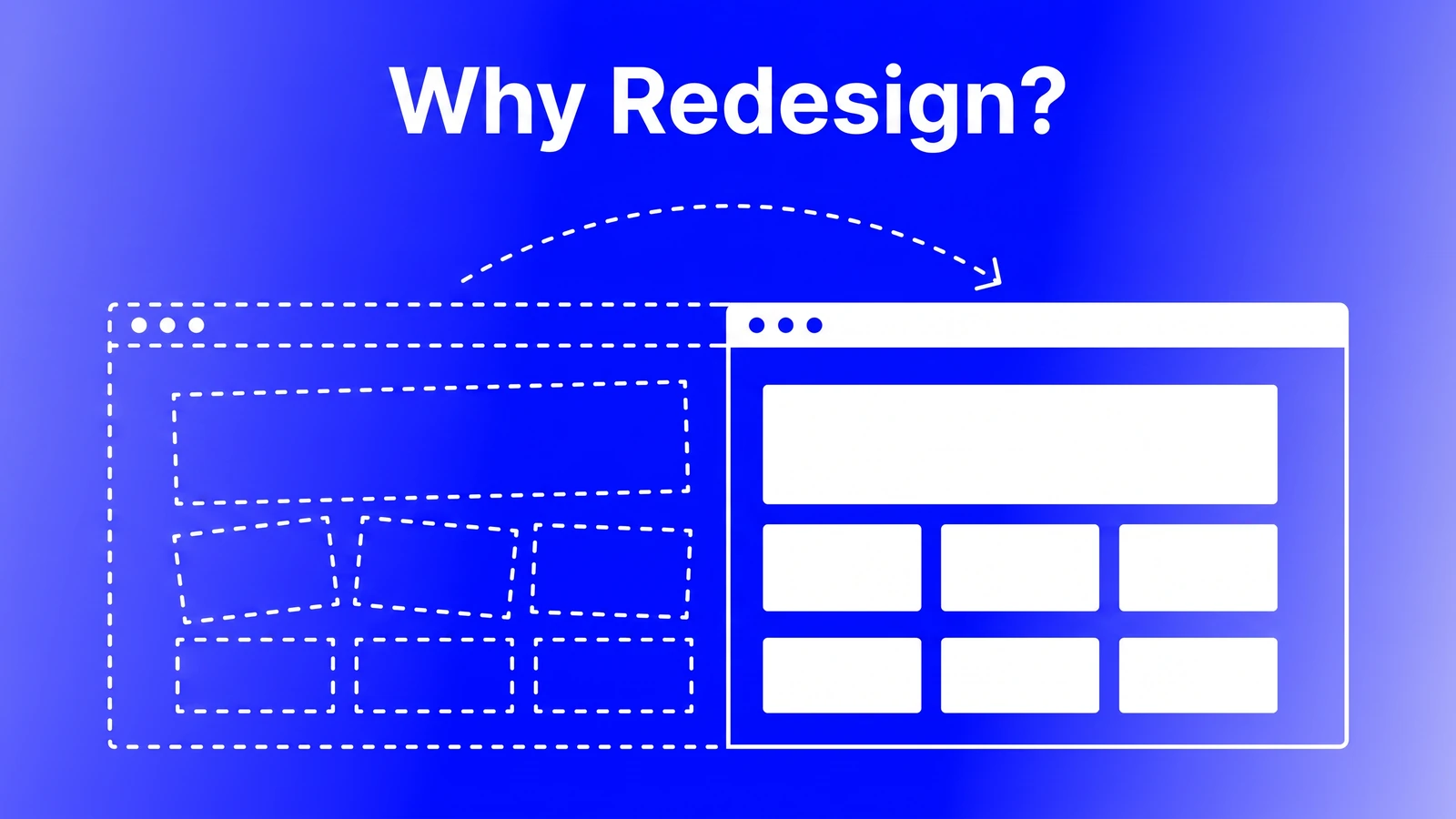


Website redesign is important because a website ages in three ways at once: the design stops matching what your business sells, the technology stops matching how your team works, and the structure stops matching how customers buy. A site more than 3 or 4 years old usually fails at least one of these, and the failure costs leads quietly, every week, without ever announcing itself.
Signs your website needs a redesign
The signs your website needs a redesign are rarely dramatic. Nobody emails to say the site feels old. The evidence shows up as small, repeated costs, and the table below pairs each sign with what it is quietly costing you. Three or more of these at once is a redesign brief; one on its own is usually a page fix.
| Sign | What it costs you |
|---|---|
| Services, pricing, or team on the site are out of date | Prospects arrive expecting the wrong offer, or rule you out for something you no longer do |
| Pages load slowly or break on mobile | Rankings drift to faster competitors, and visitors leave before the pitch loads |
| Your team cannot edit the site without a developer | Every update waits, so the site drifts further from the business each month |
| Navigation mirrors your org chart, not customer questions | Visitors cannot find the answer they came for, so they bounce to a site that has it |
| Traffic arrives but nobody inquires | Ad spend converts worse than it should; the site is the leak, not the campaign |
| The site looks older than your pitch deck | Credibility gets discounted before anyone replies to your email |
Two of these deserve a closer look because they are the ones owners most often explain away. The first is editability. A site that only a developer can change does not just cost developer hours; it trains the team to stop asking, so the accurate version of the business never reaches the page. That is how a five-year-old site ends up describing a two-year-old business. Our website maintenance services guide puts a yearly number on that dependency.
The second is traffic without inquiries. If people find the site and leave without acting, the problem is almost never the volume of visitors. It is the argument the site makes once they arrive: an unclear offer, no proof near the ask, a form nobody wants to fill in. That is a marketing-site problem, and our breakdown of marketing website cost in India shows what fixing it involves at each budget.
The three ways a website ages
Message drift. Your services, pricing, and positioning moved on; the site still describes the business you were two years ago. Visitors do not email to ask if the site is current. They leave.
Technical drag. Slow pages, broken mobile layouts, and plugin stacks nobody dares update. Speed is a ranking factor and a conversion factor, so technical aging bleeds both search visibility and the visitors who do arrive.
Structural mismatch. The navigation reflects your org chart, not the questions customers arrive with. This is the expensive one, because no amount of visual polish fixes a site that answers questions nobody is asking.
When a website revamp pays for itself
A revamp earns its budget when something measurable is stuck: traffic that never grows, visitors who never inquire, or a bounce rate that embarrasses the ad spend feeding it. It also pays before a funding round, a product launch, or a season where credibility gets checked, because prospects verify you online before they ever reply.
It does not pay when the site is under a year old, when the real problem is traffic rather than the site, or when one broken page is dragging the average. Fix the page, not the website. Our website redesign services guide breaks down the three tiers and what each costs, from a ₹4,800 template refresh to a full rebuild. For the rebuild end, our website cost guide for India gives the ranges by site type.
Frequently asked questions
Why is website redesign important?
Because websites age out of accuracy: the design stops reflecting the brand, the technology slows down, and the structure stops matching customer behavior. Each failure silently costs leads and search visibility. A redesign realigns the site with the current business, and done properly it improves speed, rankings, and conversion together.
How often should a website be redesigned?
Every 3 to 4 years is the common cycle, but the trigger should be evidence, not a calendar: outdated services, falling conversions, mobile problems, or a platform your team cannot edit. A structurally sound site can run longer with content refreshes; a misaligned one should not wait for an anniversary.
What are the risks of not redesigning a website?
Slow erosion rather than sudden failure: rankings slip to faster competitors, paid traffic converts worse, and prospects quietly discount your credibility when the site feels older than your pitch. The riskiest part is invisibility, because nothing alerts you when a visitor leaves unimpressed. The site just underperforms indefinitely.
What are the signs your website needs a redesign?
The reliable signs your website needs a redesign: services or pricing on the site are out of date, pages are slow or broken on mobile, your team cannot edit anything without a developer, navigation follows your org chart instead of customer questions, and traffic arrives without inquiries. One sign is a page fix; three or more together is a redesign brief.
Can I fix an aging website without a full redesign?
Often, yes. If the platform still works and the structure still matches how customers buy, a design-layer refresh or a rewrite of the worst pages solves most of the problem at a fraction of the cost. A full redesign earns its budget only when the structure or the platform is what failed, not the visuals.
Is Your Site Aging or Fine?
Send the URL. We will tell you which of the three failures applies, if any, and quote the cheapest tier that fixes it. Sometimes the answer is "keep it".